the famous question
Can one hear the shape of a drum?
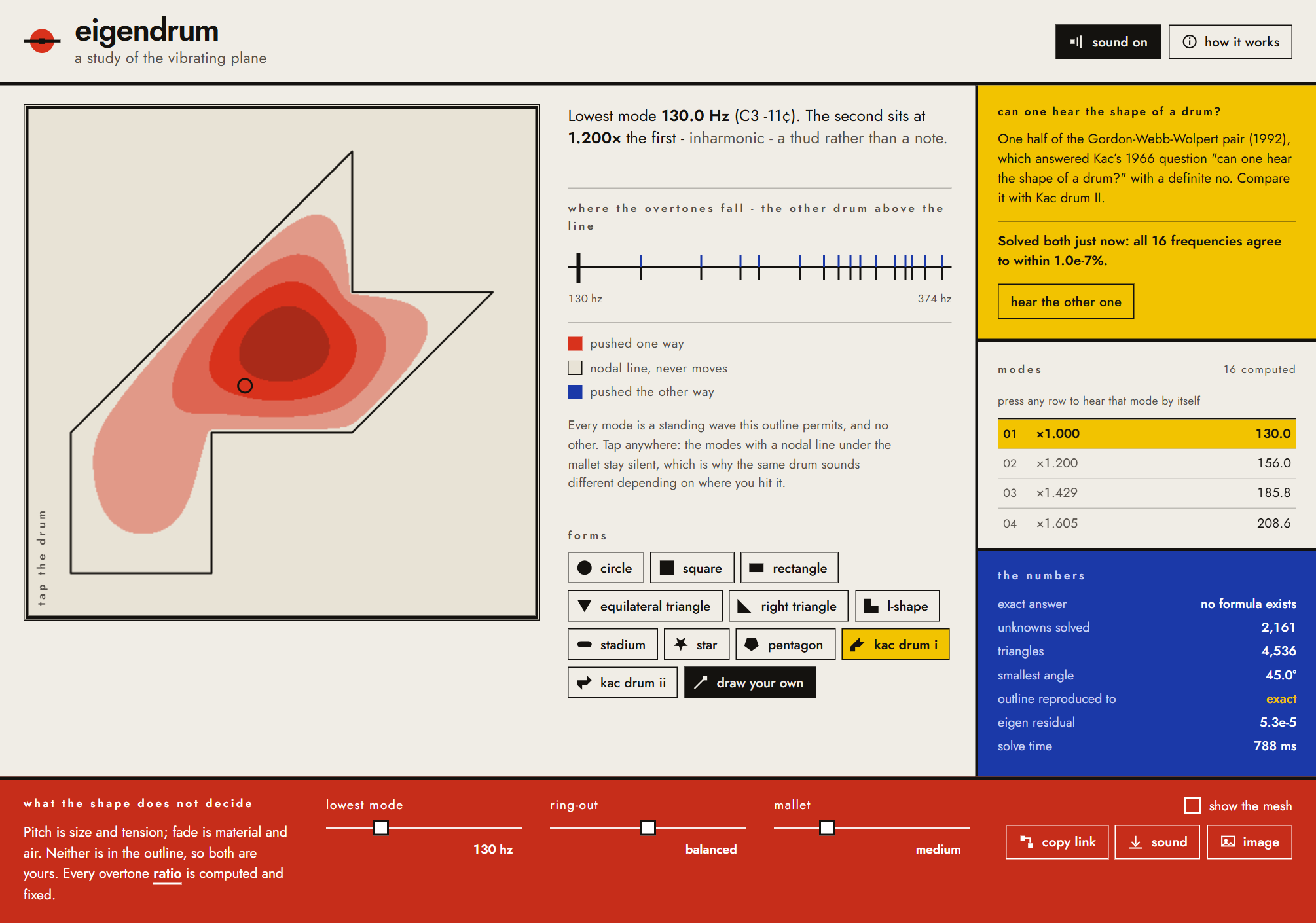
If you knew every frequency a drumhead could produce, could you work out its outline? Mark Kac asked exactly that in 1966. The answer turned out to be no - and both of the shapes that prove it are built into this site, so you can switch between them and listen.
The question has an obvious appeal, because it sounds like it should be answerable either way. A drum's spectrum is an enormous amount of information: an infinite list of numbers, all determined by the shape. Surely somewhere in that list is enough to reconstruct the outline?
And a lot is recoverable. From the spectrum alone you can deduce the drum's area. You can deduce its perimeter. You can deduce how many holes it has. These come out of the Weyl asymptotics and the heat-trace expansion - the way the eigenvalues thin out at high frequency encodes the region's geometry in surprisingly direct ways. By the mid-1960s enough of this was known that Kac's paper, published in the American Monthly under the title Can One Hear the Shape of a Drum?, made the full question feel within reach.
The answer, in 1992: no
Carolyn Gordon, David Webb and Scott Wolpert settled it by construction. They built two polygons that are isospectral - they have precisely the same infinite list of eigenvalues - and yet are not the same shape. Not rotations or reflections of one another. Genuinely different regions.
Both are in Eigendrum's form list as Kac drum I and Kac drum II. Each is assembled from the same seven right-isosceles triangles, rearranged. One looks like a hook, the other like an arrow. They enclose the same area and the same perimeter, which the spectrum already told us had to be true. And every single frequency matches.
Not an approximation that happens to be close
This is the part worth being careful about, because "the frequencies match" is the kind of claim that a numerical demo can fake by simply not looking closely enough.
Eigendrum solves both drums and reports the agreement it measured, rather than asserting the theorem and showing you one of them. When you select either drum, the partner is solved in the background and its spectrum is drawn above the same axis, so you can see the ticks land on top of each other. The measured agreement across the lowest sixteen modes is within 1.07 × 10⁻⁷ percent.
| mode | drum I | drum II | difference |
|---|---|---|---|
| 1 | 2.54398772 | 2.54398772 | 0.00000% |
| 2 | 3.66297335 | 3.66297335 | 0.00000% |
| 3 | 5.19087452 | 5.19087452 | 0.00000% |
| 12 | 15.95243552 | 15.95243552 | 0.00000% |
There is a structural reason it comes out this clean rather than merely close. Both drums have only axis-aligned and 45-degree edges, on integer coordinates. Eigendrum's mesher is built on a union-jack lattice that reproduces both diagonal directions exactly, so the two discretised problems are isospectral in exact arithmetic too, not just to within meshing error.
That was not free. An earlier version of the mesher split each lattice cell along a single diagonal, which silently staircased the other 45-degree direction. Kac drum I meshed exactly and drum II did not, so their computed spectra differed by 0.13% - small enough to look like rounding, large enough that the headline demonstration would have been a fudge.
What you can still hear
The negative answer is narrower than it first sounds, and that is what makes it interesting rather than deflating. The spectrum still determines a great deal:
- Area. Recoverable from how the eigenvalues grow.
- Perimeter. Recoverable from the next term in the expansion.
- Number of holes. Also recoverable.
- The shape itself. Not recoverable in general - and the Gordon-Webb-Wolpert pair is the counterexample that proves it.
Worth being precise about what this pair actually shows, though. Isospectral shapes aren't common - these two took real work to construct, and hearing still tells you a lot about a shape most of the time. All the pair proves is that the map from shape to spectrum isn't one-to-one. That's it, but that's enough to answer Kac's question.
Hearing a theorem
Reading that two shapes have identical spectra is one thing. Switching between them and finding the sound does not change is another. That is the whole reason this site exists: the pair is preloaded, both are solved from their outlines by the same finite element pipeline as any shape you draw yourself, and the agreement is a measurement on your screen rather than a claim in a paper.
References
- M. Kac, Can One Hear the Shape of a Drum?, American Mathematical Monthly 73 (1966). JSTOR
- C. Gordon, D. Webb, S. Wolpert, One cannot hear the shape of a drum, Bulletin of the AMS 27 (1992).
- T. Driscoll, Eigenmodes of Isospectral Drums, SIAM Review 39 (1997). SIAM - the source of the coordinates used here.
- Hearing the shape of a drum on Wikipedia, for the wider history.